Showing posts with label Brian Wilson. Show all posts

Wednesday, September 15, 2021

My Week as a Cave Man

 My Week as a Cave Man       


by Bob Coughlin


When I was a sophomore at the University of Notre Dame, academic year 1967-68, I had the most astonishing opportunity a working class boy from Euclid, Ohio ever had. For the same tuition (including room, board, books) we were paying to attend Notre Dame, $2500 per year (paid with a small scholarship, a summer job, and loans taken out by me and my parents), I was able to study in Salzburg and Innsbruck, Austria. The $2500 fee included boat travel over and back (SS United States), train travel from Le Havre, France to Salzburg, Austria, field trips, three meals a day, a shared room in a pension, and courses in German at the Salzburg Sommerschule (5-6 weeks, late July to early September), and two semesters at the University of Innsbruck. What would that cost in 2021? $60,000? More?


Anyway, we had a couple weeks of spring break in late March and early April of 1968. My roommate, Brian Wilson, and I decided we would hitchhike to Vienna, Austria, and then just play it by ear for the rest of the break. We stayed in a very odd Youth Hostel (Jugendherberge) in Vienna, in a converted Nazi bunker with thick concrete wall and doors between rooms that looked like submarine or battleship doors. The cost per night was about 20 Austrian Schillings, about 80 cents. While we were there we heard other young people talking about a town on the Isle of Crete where you could live free in caves.


From Vienna we decided to take a train down to Athens, Greece. It was a very long ride, on a train pulled by a steam engine through Yugoslavia. We spent the first night in an inexpensive hotel room in Belgrade, Yugoslavia. We were so confused by the money (“Stari Dinars”) and the language, Serbo-Croatian. I had studied Russian two years in high school so I could read the signs written in Cyrillic--and once in a while I could figure out the meaning. I do remember one funny incident at the train station. Two girls, about our age, sat down by us and tried to talk to us. We weren’t too successful communicating, but in the end I did learn two sentences in Serbo-Croation. Something like “Vreme je lepo” (the weather is nice) and “Ti si lepa” (you are pretty). To this day that’s all I know about Serbo-Croatian!


The following morning, which might have been April 3rd, 1968, Brian and I boarded a train headed to Athens, Greece. There were no seats for us on the train, so we stood for hours on end. Finally, I decided to sit--in the bathroom! The only possible place to sit on our long train journey.


After a long ride, we reached the Greek frontier at a city called Salonika (maybe more formally called Thessaloniki)--the city where two of St. Paul’s epistles were set.


Right before we reached the Greek border, a man standing near us asked us if we would claim a package as our own as we crossed the border. He said that it was a tape recorder and he wouldn’t be allowed as a Greek to bring it into the country. Brain gladly said sure, glad to help out.


When the border patrol asked to see our passports, we handed them over. Then one of the agents asked if we had any packages to claim. I said no, the truth, and Brian said, yes. So at the back of Brian’s passport the agent wrote something in Greek. and then they moved on. When we asked someone on the train what had been written, we found out that on Brian’s passport there was a statement that he could not leave Greece unless he had the package in question on him! 


O no! we thought. We immediately got off the train and ran to find some people from Customs. Brian told them what happened, that we had been tricked, and then he handed over the package (which we assumed was a tape recorder). They took the package, and then added another note on Brian’s passport which we understood to mean, “Disregard the previous note.” Since we couldn't read Greek, we were relying on other people for translations. I think Brian could have been arrested for smuggling, but they let him go and we continued on our way to Athens. We never heard what happened to the man who initiated the little smuggling operation and we never found out what it actually was. Later we found out that there was some sort of terrorism going on in Greece and that it was at least possible that this package had materials for bomb making. We’ll never know!


When we got to Athens, we found the youth hostel and did some walking around the incredible sites of Athens for a day or two, including a walk up the Acropolis Hill, wandering through the Parthenon, and admiring the Vestal Virgins (Porch of the Maidens) on the Acropolis. 

 Above, Brian Wilson (now Dr. Brian Wilson, Hilo pediatrician)

(above, me, Bob Coughlin, by the Parthenon, early April 1968. I was 19 years old)


We did have a funny incident near the Acropolis. A man on the street in front of a bar grabbed us and asked us, “Do you like girls? Do you like girls?” Of course we like girls! Then he pulled us into his bar and it didn’t take long before we found out what he was up to: “Bar Girls,” trying to entice us into buying drinks. And maybe they were more than “Bar Girls,” but we didn’t hang around to find out!

(above, Porch of the Maidens, by the Parthenon, Acropolis, Athens)


The next day, which might have been April 4, 1968 (a day that will live in infamy!), Brian and I boarded a ferry at the port of Piraeus, and headed toward the island of Crete. Our plan was to live free for a week in a cave in the town of Matala, on the south shore of Crete--the rumor circulating in youth hostels.


The ferry was very interesting, loud, and crowded (and cheap!). Music was being played all night on exotic instruments which I had never seen before. We saw women nursing their babies in public, something not seen at that time in the United States, especially at all-male Notre Dame! Some time in the middle of the night, Brian walked over to me with a girl he had met. “Bob, I want you to meet a girl from the East Side of Cleveland, Sally Kovach” [not her real name].


As we got to talking I realized I knew Sally’s cousin, who was in my class at St. Joseph High School in Cleveland. And I had been to a store that her parents owned. It was uncanny!


After a long ferry ride, we arrived in Heraklion, on the north coast of the Island of Crete. Right away we began to hitchhike. All we knew is that we wanted to go to the village of Matala, on the south coast of the island of Crete. It didn’t take long before we were offered a ride by the driver of a dump truck. Sure we would take the ride, but where would we sit? Brian offered to sit on the load of gravel, and Sally and I got into the truck next to the driver. The road was bumpy and occasionally the road was severely damaged by earthquake activity. There were places where you could see the tectonic movement rearranging the roadbed!


During the long ride, we tried to communicate with the driver and he tried very hard to tell us something. We tried English and even German (because I only knew two phrases in Greek, “Thank You” and “You’re Welcome!”). The driver knew a little German from World War II years when Germans were in Greece. He finally got it across to me that Martin Luther King Jr. had been shot and killed. I still wasn’t sure I had understood him until a little later that day.


We finally got left off at an archeological site known as Phaestos, a 4-6000 year-old Minoan site, one of the most important archeological sites in the world. Unfortunately, we spent a very short time there because we had a long walk to Matala, about 22.6 kilometers!


Bouzouki


We travelled pretty light in general: we each had small backpacks and sleeping bags. But we did have one large item: Brian's guitar. The guitar became a great entré device. One person we met on our long walk asked to see Brian's guitar and started playing "Never Kiss Me on a Sunday," a song with a Greek feel about it.


Further down the road a man saw the guitar and invited us into his beautiful little home. Then he pulled out his pride and joy, a spectacular bouzouki.


He played it for us and agreed to pose with his family and his priceless bouzouki.


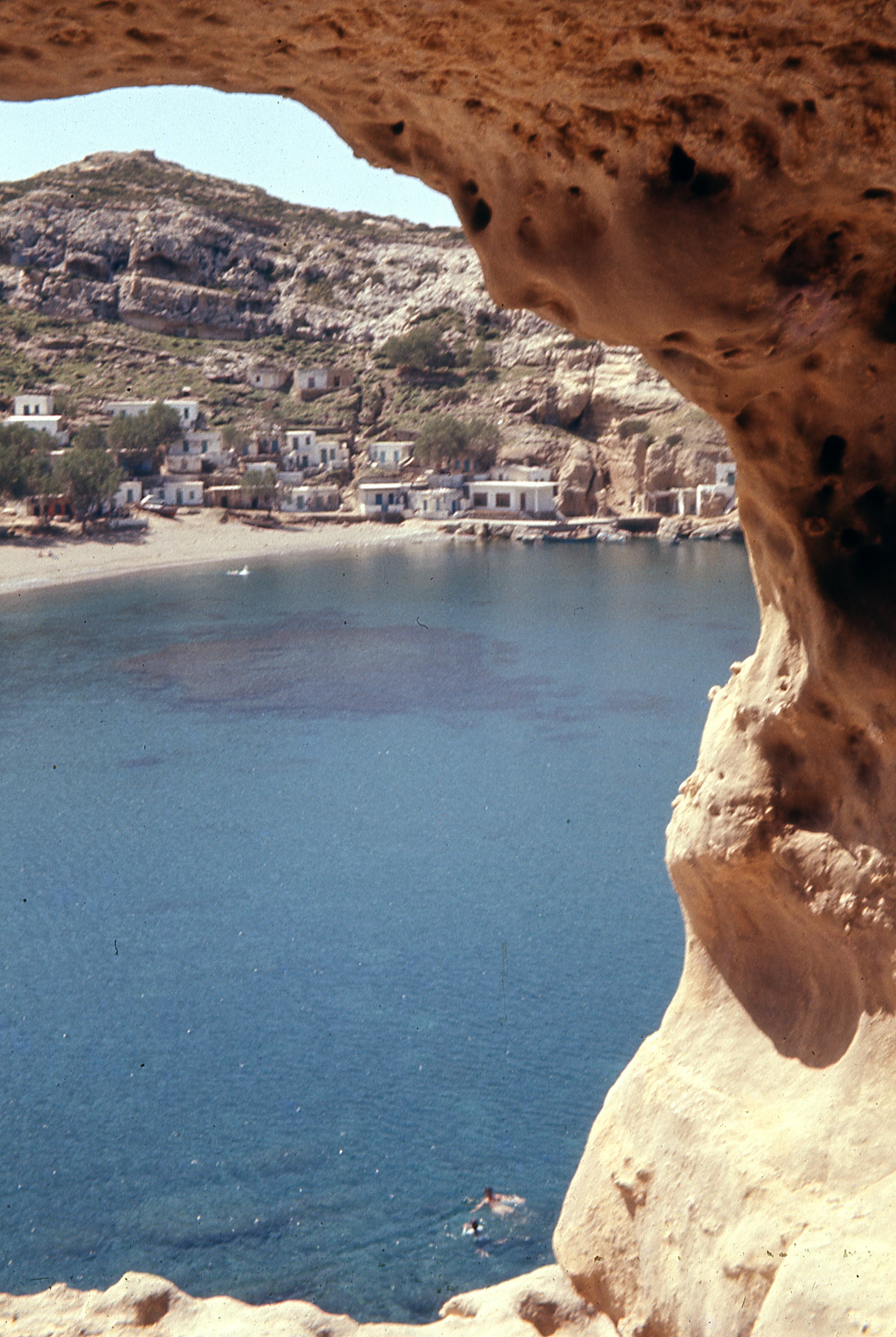
[Below, a few photos I took of Matala and our cave. I wish I had taken more, but film was expensive for us as was developing film and getting prints. In one you can see one of the cave-pocked hillsides by the little cove. In another, the tiny village of Matala as seen from inside our cave. I think that's Brian swimming below. In one photo, taken from the hilltop, you can see the caves on both sides of the cove and an island 10-20 miles off shore.]



Brian and I continued on the dirt road to Matala. At one point we encountered a rather fancy restaurant with people sitting outside at little tables. To my astonishment, they were eating snails! I had never even heard of that back then.


We finally arrived in Matala. It was a very tiny village, hardly a village at all. It was set at the head of a small cove of blue-green water that opened up to the Mediterranean Sea. In the distance you could see a small mountainous island. And far in the distance you could see snow-covered mountains. On each side of this cove were steep hillsides pocked with caves, many on each side. Brian and I found a cave up about 40 feet above the water and that’s where we stayed for the week. Our cave was clean and empty, carved out of the stone. It might have been about 9 feet square approximately, big enough for us to lay down our sleeping bags. I remember there was a kind of stone bench inside the cave, nothing else. At the time we had no idea how these caves got there--they seemed to have been made for us, ha ha. But as I think about it now, I wonder if these had been burial caves at one time.


I can hardly remember the details of living there. We did go in swimming, but the water was fairly deep, clear, and cold (Brian swam more often than I did). And we got some meals at a tiny little restaurant there. I remember getting delicious egg omelets. And I do remember one evening drinking the inexpensive local red wine. I was pretty “beschwipst,” and faced some danger getting back to my high-level cave. And the next morning, I had a terrible headache from the red wine.


I remember one day wandering on the hilltops above the cave in incredible fields of wildflowers buzzing with bees. It made me think that the honey used in delicious baklava was made by these bees!


A few years after our sojourn in Matala, Joni Mitchell, the great Canadian singer-songwriter, wrote a song about her visit to Matala, the song “Carrie.” The words of the song are pretty accurate though in 1968 Matala wasn’t exactly a tourist town--that happened soon after. I don’t remember the tiny restaurant being called the “Mermaid Cafe,” though it might have been. And for historical purposes, I want to make it clear that neither Brian nor I was “Carrie,” ha ha. We didn’t steal Joni’s camera and didn’t sleep with her, at least I didn't.😉


Lyrics to Jone Mitchell's song "Carey"


So after a week or maybe less, Brian and I left Matala and started the long trek up the dirt road to a place where we could hitchhike. Amazingly, an army troop vehicle stopped and picked us up. With our backpacks and guitar, Brian and I entered the truck. There sat around 10 soldiers in full battle array. The truck drove on for a short distance and then for reasons unknown to us, they stopped and ordered us to get out, which of course we did (they all had guns; we had a guitar). We were unaware of the political situation in Greece at that time, but I think there had been a coup d’etat and the army was on terrorist watch. So we were happy to start walking again.


We finally made it to Heraklion, on the north coast of Crete, after many hours of walking and hitchhiking. There we caught a ferry boat headed for Bari, Italy. We had started on our way home to Innsbruck, Austria. A few more adventures awaited us.


Italy


Our ferry finally arrived at the city in Bari, a fairly large town on the southeast boot of Italy. Then we found the road west and hitchhiked across Italy. We arrived in Napoli on Good Friday or Holy Saturday, that is April 12 or 13 of 1968. Martin Luther King Jr. had been dead for a little over a week and we finally started seeing Italian newspapers covering the chaos, anger, and riots back in the USA. We still had not seen any TV or heard any radio (and the truth is we saw almost no TV nor heard any radio that year we were in Europe).


We went to mass on Easter Sunday, April 14th, at what I think was the Cathedral in Naples. There was a level of poverty in Naples that I hadn't seen before and I was amazed at the density and excitement if the city. One thing that surprised me was the commerce taking place during mass on the steps of the church, unheard of in America.


One remarkable thing I remember about Naples is the great volcano, Mount Vesuvius, not far from town. Unfortunately I didn't go to Pompeii, the famous city buried in an eruption of Vesuvius.


The day after Easter, Brian and I started hitchhiking toward Rome. Unfortunately, we got separate rides and would be separated for days until a miraculous reunion in Northern Italy.


On my way to Rome I was picked up by a young Italian couple. We struggled communicating but got by with bits of Italian, English, German, and Latin. The took me up to Monte Casino, where St. Benedict established the Benedictine order and rule about 1500 years ago. As we drove up the small mountain toward the monastery, they told me about the Allied bombing of 1944 that destroyed the building. By 1968, the monastery was fully restored. I was embarrassed that my country had destroyed this historic monastery.


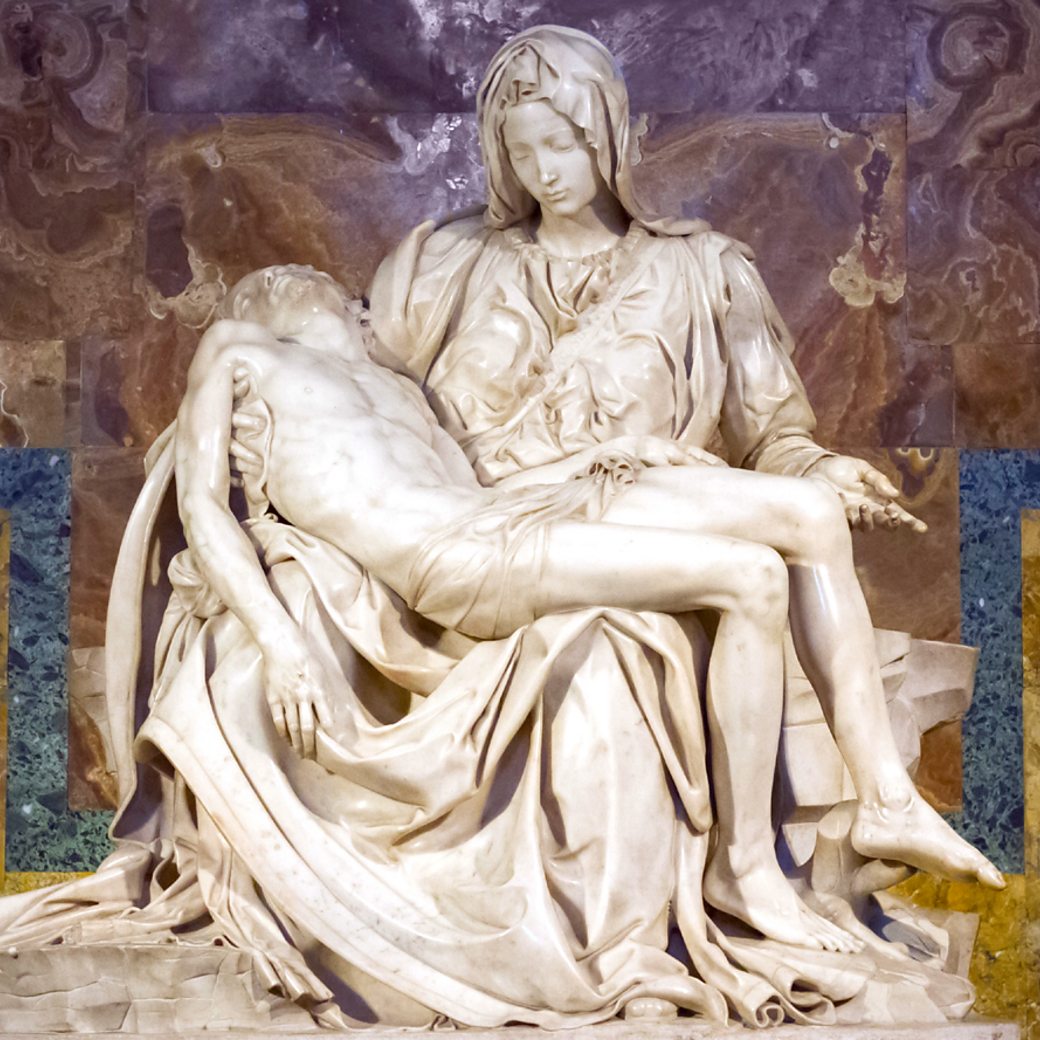
Rome. When I arrived in Rome, I located a youth hostel and began my wanderings in the city. I now had almost no money and a long hitchhike back to Innsbruck--and I was by myself. I had no idea where Brian Wilson was and back then there was no way at all to communicate with him. I started wandering around Rome on foot and found my way into Vatican City. I had no guide book, no money, and I was on foot so I didn’t see much of Rome. The parts of the city I saw included pretentious Mussolini-like memorials (the Victor Emmanuel II Monument) and very busy streets. Luckily the Vatican was quieter and more intimate. I walked around St. Peter's Square and I was lucky enough to see the Pietà, one of the greatest works made by human hands. Michelangelo carved this from Carrara marble circa 1498-99 and it’s at home in St. Peter’s Basilica. 


(Above photo from a Google search)
I also saw the Roman Forum. I was struck by how strange the forum looked, everything in ruins, and I didn’t know how to think about it.


North to Bolzano. From Rome I headed north and got a ride in a little sports car going 120 mph on the Autostrada. I felt relieved when I got out! The trip to Bolzano was about 380-400 miles, a long day hitchhiking back then. But I made it to the bilingual (German and Italian) town by 6 pm or so and immediately tried to figure out where I was going to sleep that night: I had no food and no money. What was I going to do?


Bolzano, Italy has another name--Bozen, in German. After World War II, the area called “Süd Tirol,” was taken away from Austria. The area had long been trilingual--German, Italian, and Ladin (an Italic language derived from Latin, spoken in certain mountain valleys). There was huge resentment even in 1968 about this and there was occasional acts of terrorism and you could see graffiti around stating “Süd Tirol bleibt Deutsch"-- "South Tyrol remains German." So that is the background.


I looked around town for a place to sleep and spotted the bed of an old pick up truck outside a house. Maybe I could lay my sleeping back down there and then get up early before the people in the household. So that’s what I tried to do, but I caught the attention of their dogs, and a very angry Roma man (what we used to call a Gypsy) ran out of the house and I quickly grabbed my sleeping bag and rucksack and ran! Guess I wasn’t going to sleep there.


After that I tried to find a park with a bench. It was now getting dark. There was someone in the park, but she left, so I stretched out my sleeping bag on a bench and tried to go to sleep. It wasn’t long before a federal policeman, a carabinieri, came by, machine gun in hand, and ordered me to stand up and raise my hands into the air. He spoke to me in Italian and I answered him in German, which made him even more suspicious. Then he began searching me and my pack for, I suppose, bombs. I tried to explain to him, in German, what I was doing, that I had no money left and was travelling north to Innsbruck, Austria. He finally accepted my explanation and then told me to go sleep in the train station. So again I gathered my sleeping bag and backpack, and headed to the Bahnhof to sleep. I went inside and tried to sleep sitting up on a bench. But at a certain time of the night, everyone had to leave the inside of the train station, no exceptions. So i went outside and wondered what I should do. Finally I did something crazy. I stretched my sleeping back out on the steps of the train station and went to sleep. I actually slept--I was so tired! Very early the next morning, I woke up and looked around and saw a crowd of people gathered around, wondering who was in the sleeping bag and what the heck he was doing there! 


So I got up, rolled up the sleeping bag, grabbed my backpack, and started walking. By now I was very hungry, and almost totally broke. I walked for about 15 minutes when I saw a guy walking toward me. It was Brian Wilson, who I last saw in Naples! I was so happy to see Brian, and my first remark was, “Brian, do you have any money for food?” He did, hurray, and Brian and I got breakfast and soon started hitchhiking the last stretch, across the Alps, to Innsbruck, Austria. 


Thus ended an incredible couple of weeks and my week as a cave man!


[I took all the photos in this piece except for the one of the Pieta.]


Wednesday, April 8, 2015

Remembering April 4, 1968--When Martin Luther King Was Murdered

The day after Martin Luther King Jr. was killed, April 5, 1968, I was riding in a truck across the island of Crete. I was hitchhiking with a girl we met on the ferry boat sailing from Athens to Iraklion, a guitar, and my buddy Brian Wilson. Having a guitar was a great way to hitchhike--it offered instant entree. Having two guys, a girl, and a guitar--that was a little tougher.

On the ferryboat Brian and I met an American girl--I think we were the only Americans aboard that trip. Turned out this girl was from Eastlake, Ohio. I knew of her father's clothing store at E.222nd Street in Euclid. I even knew one of her cousins.

When we got off the ferry boat in Iraklion, we hitched a ride on a tiny motor scooter (well one of us did) and then got to the main road that crossed the island. Our destination was Matala, the tiniest of villages, on the southern coast of the island. Hitchhiking was tough because there was almost no traffic. Almost no one owned a car. We finally got a ride in a dump truck. The Eastlake girl and I (and the guitar) got in the front seat with the driver. Brian wanted to ride up on the load of gravel--a dangerous and uncomfortable position for him. While we were driving, we tried to communicate with the driver, but it was difficult. We only knew a few phrases of Greek, and he knew just a little English. He did know some German, so between these three languages he told us of the assassination of Martin Luther King. Still, I could hardly believe what I heard, and it would be hours more before King's murder was confirmed for us.

On that trip across Crete, we stopped at an archaeological site (very famous, very important, unbeknownst to us) called Phaistos.

Image of Phaistos, found in Wikipedia

We spent some time looking around the site, and then proceeded to the long walk to the village of Matala. On the way there, a man saw Brian carrying his guitar and invited us into his house. He wanted to show us his bouzouki, a spectacular instrument that must have cost the equivalent of weeks of work. We got to meet his entire family, and we took this beautiful photo with his three children. What a blessing to be invited into this home!


Matala, Crete family--circa April 5, 1968 (this might have been closer to Pitsidia than Matala)
From here we walked to Matala. There was a dusty road, with absolutely no traffic. I'm guessing we walked a couple of hours, finally arriving at the tiny village on a blue cove on the Mediterranean Sea. Either side of the cove was lined with cliffs, and in the cliffs were carved-out  caves--which, we assumed, were once used for burials. We found an empty cave and lived in it for a week.

A view of one of Matala's cliffs, with caves. [WWW.visitMatala.com]


A year or two later Joni Mitchell came to Matala. She wrote a beautiful song about the village and the "Mermaid Cafe" and the local wine and a boy named "Carey." I'll try to find a Youtube version of that:


So that was the day we learned Martin Luther King died. While in Crete, we had no news, no telephone, nothing, So we didn't have any sense of how America exploded after the assassination.

Postscript. I had a couple more memories of that visit to Matala and Crete I thought I'd mention. When Brian Wilson and I were walking to Matala, we passed through a little village where we saw people dining outside. I noticed they were eating escargot--snails. That was the first time in my life I saw people eating that! I'm guessing this was the village of Pitsidia. Maybe that's the town where we met the Greek family seen in the photo above.

Here's another strange memory. As we were hitchhiking back to Iraklion, an army convoy drove by us, then stopped and told us to get into the troop truck. We got in, with our guitar and backpacks. About 20 soldiers sat stiffly inside the truck, not speaking to us. Then, a few minutes later, someone in charge, maybe a sergeant or an officer, ordered us to get out of the truck. We had no idea what was going on. I do remember seeing the soldiers' weapons during this incident, but I wasn't really afraid. About a week later, in the Northern Italian (German-speaking) town of Bolzano, I was searched by an Italian federal policeman, a "carabinieri," with his machine gun pointed at me. Again, that ended without an actual arrest and with no violence.

Monday, January 12, 2015

Revisiting My Adolescence--Skiing at Age 66 on Big Mountain, Whitefish, Montana

My first time skiing was around 1962, as a Freshman at St. Joseph High School in Cleveland. We would go in a school bus to a ski area in Chesterland called "Mont Chalet." This was a  beautiful little hill, maybe a vertical drop of 250 feet (tops!), with a run of a couple of hundred yards. I have fond memories of Mont Chalet and our bus trips there. One time we actually started slipping backwards on a snowy Tibbetts Road (which connected to Caves Road). The bus driver put on the emergency brakes, and we escaped the bus and pushed it up the hill!

By the time I was a senior at St. Joe's, we started going to Alpine Valley Ski Area in Munson Township, Geauga County. That area had a higher vertical and longer runs--but really it was quite short compared to ski resorts in New England or in the Mountain West.

My real development as a skier happened the winter of 1967-68, when I studied in Innsbruck, Austria--Sophomore Year Abroad, a Notre Dame program. I took a week of skiing lessons at an Austrian youth ski school in the week after Christmas that year, along with my classmates Brian Wilson, Tim Forward, and Benny Thomas. We got a week of lessons in Obergurgl, Austria, plus room and board (Matrazen Anlagen--German for mattresses butted up against each other in an open dorm room)--the cost was an incredible $18.00, if I remember correctly. Anyway, that week of lessons paid off and got me in very good shape. The Austrian teachers did not believe in using ski lifts. We skied down the mountain and walked up--every single time. We worked on our skiing for about 6 hours per day. I was a pretty good skier after that week!

Below is a much more recent photo of Obergurgl, found using a Google search:


After my year in Austria, I skied very little. Occasionally I would go to Alpine Valley or Brandywine/Boston Mills. On two occasions, I made quick trips to Killington, Vermont (hilarious stories with those trips). In the 1990's and early 2000's I went to Holiday Valley or Peak 'n Peek in western New York State a few times.

About 6 years ago, when my daughter Carolan was living in Frisco, Colorado (and working at the Copper Mountain Ski Resort), I got to ski on that huge mountain. I was able to do OK, which surprised me. But I remember how my thighs burned the whole way down the mountain. You have to have very strong legs to ski on the the Rocky Mountains. You also have to put up with very cold weather. The day we skied on Copper Mountain it was about 10 below zero!

So after not doing any downhill skiing for the past six years or so, I went skiing a few days ago on Big Mountain, just outside of Whitefish, Montana. My daughter lives at the foot of the mountain and has a season's pass for skiing. So with rented skis and her ski discount, I skied with her and her friend Jeremy Rust on Big Mountain, an incredible skiing venue.

Below are some photos from our Big Mountain adventure:

Carolan skiing down the Hellroaring Basin (photo by Jeremy Rust)

Bob and Carolan hollering "Ski Heil!" Flathead Valley in the background. Jeremy took this one too.

Atop Big Mountain.

I made it down a fairly steep slope. I can still ski!

Carolan and Bob at the summit. Glacier National Park mountains in the background.

A better view of the great peaks of Glacier National Park, from atop Big Mountain

Carolan and Bob

Linda and Carolan


Saturday, November 22, 2014

I remember November 22, 1963--The Murder of John F. Kennedy

I wrote this a few years ago and want to post it again on the 54th anniversary of the assassination of John F. Kennedy, something that still wounds me deeply:

It would be hard for anyone outside of my age, ethnic, social, and cultural context to understand how November 22, 1963, the assassination of John F. Kennedy, is etched on my soul. There is no adequate metaphor: etched, branded, tattooed. The day, the death, the memories will always be there, always be a part of me.


I think in part it's because John Kennedy, "Jack" we liked to call him, as if he were a friend of the family, it's because he represented what we longed to be. I was from a struggling, working-class Irish-Catholic family. John Kennedy came from the same roots--the exiled Irish, streaming out of famine and post-famine Ireland, where there was massive death, disease, and starvation everywhere. And then trying to find your way in a new society. By the time I was born in 1948, we had come a long way--90 years after our immigrant great grandparents came to America's shores. We had a lot of wonderful gifts: our tight Catholic religious community, our large and loving families and extended families ( I joke that my parents and I didn't have friends--we had relatives. It is the truth!). But we also had terrible problems with alcoholism, untreated anxiety and mental illness, and we faced  plenty of prejudice. Very few people acknowledge that now, but it was the truth. Catholics, even in the 1950's and 1960s, were victims themselves of discrimination and prejudice (and we were full of that same vice towards others, I am sad to say). John F. Kennedy seemed like a vision to us, of what could be: he was more handsome, richer, better educated--yet full of his own problems, we later discovered, many far worse than our own ills and sins.

When I heard around 2:05 PM that November 22nd, that Black Friday, sitting in my religion class as St. Joseph High School in Cleveland--when Brother Stanley Matthews came over the PA system and told us, "Boys, he's been shot. The president has been shot," we were stunned beyond belief. It was as if my own Father had been shot. I remember how we prayed for the next half hour, when Brother Stanley came on again and said, "Boys, he's gone, he's dead. Pray for him, his family. Pray for yourselves and the world."

And that is what we did.

We, of that generation, knew a lot of terrible deaths, and we took them personally. John F. Kennedy, Martin Luther King Jr., Robert Kennedy. And then the Vietnam War, and cousins, classmates, friends getting killed: Tommy Fitzpatrick, Buddy Chasser, Steve Shields.

So I am marked by this day. I know my cousin Maggie Brock is also deeply marked. As are so many in my family, among my friends, in my generation.

Five years after John F. Kennedy's assassination, Brian Wilson and I were traveling in Greece during our spring break (we were Notre Dame students studying abroad in Austria). It was the day after Martin Luther King Jr. had been murdered. Brian and I were invited into a modest home near Matala, Crete. The man of the house wanted to show us his bouzouki and tell us of relatives in America. On the wall of his home were two pictures: Pope John XXIII, and John F. Kennedy.

John XXIII

 Pope John would not have been his religious leader, for this man was Greek Orthodox. And JFK would not have been his president. But there it was--two heroes. Yes, we know JFK's clay feet, we know his catalogue of sins and faults. But I was inspired by him to try to make the world a better place. And his assassination on this day 51 years ago is etched indelibly into my heart.

Postscript: Pat Denny, a friend of mine, read this blog entry and sent me some of her own reflections on that fateful day. Pat was a freshman at Regina High School in South Euclid on November 22, 1963. Here is what she wrote me--I appreciate it so much!

"We were in an assembly.  Principal (Sr. Mary Marthe) interrupted the program when the news was first announced.  The program resumed, and later she returned and ended the program when the news of his dying came in.  All our buses came earlier than usual, as I'm recalling.  We all prayed the rosary all the way home from Regina to 260th bus stop in Euclid.  Overwhelming sadness and grief punctuated that entire weekend, and for many days after as we followed the TV coverage.  We were at such an impressionable age when it happened. Our hearts still ache when we recall it all."

Friday, October 17, 2014

Notre Dame Classmates. Salzburg-Innsbruck Program, 1967-68.


I was a Notre Dame student from 1966 to 1970. I spent my Sophomore year in Salzburg and Innsbruck, Austria. For a working-class boy from Euclid, this was close to a miracle. There were 36 of us in this program, and many of my classmates have had extraordinary careers and lives. From left in the black and white photo, you can see Jim O'Connell, now a very famous and much honored physician to the homeless in the Boston area. To his right, Brian Wilson, a pediatrician in Hilo, Hawaii. Then Al Issenman, a professor at Northwestern. Bob Wingerson, from the Detroit area left of Al. Then Charlie Schaffer (not sure what he's doing); then Tim Berry, a successful journalist and now a business owner in the Pacific Northwest; Jim Peters and Colm Gage next; then Steve Tapscott, professor at MIT, distinguished poet and translator; me next; Leo Lensing, distinguished professor of German and our class's valedictorian; Paddy Laflin; and on the right, Dick Riehle, well-known character actor (probably been in a hundred movies and many tv sitcoms). Tim Berry posted both of these photos on Facebook.
The Notre Dame boys of the Schmelzergasse Pension. Innsbruck, Austria. I'm fourth from right. 1967.

Notre Damers. Maybe Schloss Klessheim, outside Salzburg. I'm front left, pointing. 1967.

Friday, April 4, 2014

Martin Luther King, Jr. My Memories of that day 46 years ago

[This is a reposting of a blog entry from years ago]

My roommate Brian Wilson and I got on a ferry boat at Piraeus, Greece, just outside of Athens the evening of April 4, 1968. We hadn't seen a newspaper in days and were far from any televisions or radios--blissfully cut off from the Vietnam slaughters and the American race wars. The ferry was heading overnight to Iraklion, a city on the northern coast of the island of Crete. It was a very crowded boat, not luxurious in any way (and that was fine with us). Overnight some of the Cretans were playing a wild music on some sort of folk instrument played with a bow. Brian Wilson met a girl on the boat from Eastlake, Ohio, a Cleveland suburb just miles from my home in Euclid. I actually knew some of her relatives and had shopped in her family's little clothing store in Euclid. A young mother in my quarters pulled out her breast in public and began nursing her baby. I was astonished beyond belief, never having seen anything like that back home. I slept a little that night in the crazy cacophony, in a setting where Zorba the Greek would have felt quite at home.

In the morning we arrived at port in Iraklion. We hitched a short ride up a hill on the back of a moped and then began walking. We had only a vague clue where we were headed. Somewhere we had heard a vague rumor about a place on the south central coast of the island where we could live free in caves. The place was called Matala, so we decided to head there. When we got out of Iraklion, we began hitchhiking. Unfortunately for us, there were hardly any cars at all on the roads. Finally a truck came by carrying a full load of gravel and stopped. The girl from Eastlake and I hopped into the cab, but there wasn't room for Brian and his guitar. The driver signalled for Brian to get up on the load of gravel, which he did. We began driving over the incredibly bad roads of Crete, occasionally passing by areas where the road had been utterly ruined by earthquakes. I passed the time trying to talk to the driver. I only knew a few words and phrases of Greek, but I discovered he spoke some German--apparently useful in Greece during the World War II era. And that's when he told me: that Martin Luther King had been murdered. His German was shaky enough that I wasn't sure exactly what he was telling me: that the king was dead, was shot. The driver was deadly serious about this and he certainly communicated to me that something very serious, very terrible, had happened.

We had a few more rides that day and walked a great deal. We walked right past one of the most historic archaeological sites in the world: "Phaistos," an ancient civilization, almost a birthplace of the world I lived in. The final 10 miles or so of our journey was on foot. There were no cars, no buses, and very primitive roads to Matala. I do remember one beautiful moment. A Greek man noticed Brian's guitar and invited us into his home. He spoke a little English and introduced us to his family, told us of relatives in America. He brought out his pride and joy, a magnificent bouzouki, one that must have cost him a year's wages, and played it for us. I took a photo of that scene, inside this Cretan house, the man holding his bouzouki, his wife and children by his side. About 4000 miles away in America, all hell had broken loose. The grim tide of blood and chaos that WB Yeats had spoken of had been unloosed. Evil and hatred had its day in America, while Brian and I were so blessed by this man and his family in Crete.

Saturday, March 1, 2014

Vietnam Era Societal Tensions: Race, War, Gender

My niece Rachel Sanders has asked me to respond to this question about the Vietnam War Era:

3. What were some of the tensions in society? Was there racial and gender equality?

As I have said in some of my previous responses, my awareness of social issues and tensions gradually developed over the long course of the Vietnam War. My first thoughts on this: the justness of the war and racial tensions were the two biggest issues for most of that era. The Civil Rights struggle predated the Vietnam War, but came to a head in the mid to late 1960's. During that time we have the passing of landmark civil rights legislation, and the murder of figures like Martin Luther King Jr. and Malcolm X. We had the Montgomery Bus Boycott, the Freedom Rides, and sit-ins all over the country. We also had what were called "race riots" in many cities, including Cleveland and Cincinnati. I think "race riot" is a disgusting and misleading term that doesn't begin to get to the complexity of what was happening. I myself felt deeply the murder of Martin Luther King Jr. I remember where I was when I got the news--a strange place indeed. I was hitchhiking across the Grecian isle of Crete. I was riding in a dump truck, along with Brian Wilson and a girl we met on the ferry (She was from Eastlake, amazingly enough). Brian was actually riding on top of the load of gravel being carried by the dump truck. This terrible murder was compounded 2 months later with the murder of Bobby Kennedy. How could we explain America to the Europeans we were going to school and living with after these two terrible events?

Of course, the Vietnam War created almost unbearable tensions, between families, friends, relatives, everybody. To be against the war risked banishment, shunning, almost exile from your family--at least in the earlier years of opposition to the war. Later, the anger against the war culminated in gigantic demonstrations in Washington, D.C. And I was proud to march in these demonstrations.

The issue of gender was never on my mind until very late in my Notre Dame years, say 1968-70. And then that issue exploded into consciousness. I will never forget an incident that took place in the Mansfield Community House in Cincinnati around 1971. We were sitting around after the communal supper and apparently I was pontificating on something. I happened to use the word "mankind" and two or three of the women present walked out of the room because of my use of that word. I learned to be very careful of my word choice! I stopped using the word "girls" to refer to these young women. And "mankind" became "humankind." It was a painful lesson, and maybe not totally fair toward me. But it was a good lesson. I later learned to respect and love these women, many of whom are still working hard for peace and justice.

Thursday, March 14, 2013

Friends Since 1967


Bob Coughlin, Tim Forward, and Terry Forward (and Emmy-the-Dog). March 14, 2013. Rochester, New York. I met Tim in 1966 or '67. Studied with him in Salzburg and Innsbruck, Austria. Then back at the University of Notre Dame, 1968-70. Tim met Terry around 1972 or '73 in Berchtesgaden, Germany, when Tim was in the army. Tim was a "typist." The first thing he ever said to Terry, "Where's the 'e' on this thing?" Of course you wouldn't forget a crazy line like that!

Tim and I (along with Brian Wilson and Benny Thomas) spent about 10 days in late December 1967 and early January 1968 in Obergurgl, Austria, taking a ski course at an Austrian youth instructional facility. The cost for instruction, room, and board was about 20 bucks, if I remember correctly. I recall that the instructors never allowed us to use ski lifts. We sidestepped and herringboned our way up the hills. By the end of the session, we were good skiers, in fine physical shape. While in Obergurgl, we met a couple of nice Austrian girls, Caecilia Werth (now Cilli Kirchmair), and Liselotte Schartner.

Monday, September 20, 2010

Notre Dame-Innsbruck Friends from 1967-68


The 1967-68 Notre Dame Innsbruck Program:

The top photo looks like something out of "Lucy in the Sky with Diamonds" and the Magical Mystery Tour! It shows some of the Ehrlerstrasse Pension gang drinking beer, strumming guitars, and wearing funny hats (the hats belonged to Steve Shields). Included here are Mike Celizic (seriously ill these days), Chris Cotter, Steve Shields, and Mike Gerrity. The special effects in this photo are the products of chance, time, the print being rolled up in a tube for years, blood, sweat, tears, and probably some measure of alcohol.
The bottom photo shows 5 members of the Notre Dame-Innsbruck Program, probably in September of 1967 at "Eisriesenwelt," gigantic ice caves outside Salzburg, Austria. In this photo you can see Steve Shields (died in Vietnam, circa 1972); Charlie Bradley; Brian Wilson; Bob Coughlin; Mike Gerrity. There was quite a scary hike to get to the caves, including a trek across a cliff face (holding on to cable affixed to the rock). I can't remember who took this photo.

Thursday, January 29, 2009

Skiing in Austria (Part 2)

My NotreDame-Innsbruck friends and I skied all around Innsbruck (and adjacent countries, Germany, Italy, and Switzerland). In Innsbruck we skied occasionally on the mountain called "Patscherkofl," just south and east of Innsbruck by the beautiful village of Igls. You took a Seilbahn, a cable car, up Patscherkofel, and got off about 300 hundred meters below the bald, treeless peak of this characteristic mountain of the Innsbruck area. I believe it was possible to ski from the very top, but the snow could be sparse and icy, and the winds could be ferocious without any tree cover at all. We would ski down a trail through the forest called the "Herrenabfahrt," the men's downhill run from the 1964 Winter Olympics. If you wanted scary, this was scary, especially if, like a downhill racer, you went full out through the forest. A false move, an icy patch, and you could be dead. I traversed, crisscrossed, the trail, slowing my speed and increasing my safety.

Another place we skied was on the Nordkette, the northern chain of mountains just north of Innsbruck and the Inn River valley. This involved taking a funicular train from the valley floor up to Hungerburg, and then a cable car up to the area called "Seegrube," about 2000 meters of elevation above see level. There was a decent ski area at Seegrube and a nice terrace to sit in the sun on warm days (which were fairly rare). If you were very brave and crazy, you could take the final step, via cable car, to the very top of the Nordkette, the peak called "Hafelekar," and try to ski the narrow and incredibly steep shoot, 1000 feet vertical drop, from Hafelekar to Seegrube. Then, you could ski the zigzaggy trail, perhaps a mile long, the rest of the way down to Hungerburg. From there, the funicular back to the Inn Valley and Innsbruck (except, if you were cheap and broke, like I was, you could walk the train track back to the city. Brian Wilson and I did that one time and my thighs ached for 2 weeks).

Who did I ski with most often? It's hard to say, but I imagine my ski companions included Tim Forward, Brian Wilson, crazy Patty Laflin, Bob Wingerson, and really most of the other Notre Dame-Innsbruckers. Only a couple didn't ski.

Uebrigens, by the way, Tim Forward is an architect, Brian Wilson a pediatrician, crazy and brave Patty Laflin became an FBI agent, and I've lost track of Bob Wingerson, but I believe he still lives in the Detroit area.

[More coming in "Skiing in Austria, Part 3"]

Thursday, January 8, 2009

Making Music (Part 1)

[Part 1]. Music must be one of the great consolations, one of the great pleasures of life. I wish that my parents had encouraged (cajoled, threatened, forced) me to take music lessons as a kid. We didn't think about making our own music in my family, alas, but I began to make music for myself junior year at St. Joe's High School in Cleveland. The inspiration was Pete Gasper, my classmate, and the music of the Beatles. Pete was also my inspiration to begin writing poetry. Pete was one strange and interesting dude, a fellow living in Eastlake, born of Portuguese heritage, who discovered that he could woo girls via poetry. Where is Pete today? Did he continue his pursuit of poetry? and girls?

Anyway, Pete set me on the path. I bought an inexpensive Hohner harmonica and began playing by ear, with absolutely no instruction and even without many musical models. Eventually, the models became the harp riffs on some Beatle songs and the harmonica parts in Bob Dylan songs. I eventually got pretty good on the harmonica, at least good enough to entertain myself.

A couple years later, I roomed with Brian Wilson (the Hilo Pediatrician, not the Beach Boy) during a Sophomore Year Abroad program in Innsbruck, Austria. Brian had a guitar and was an excellent player. He taught me to play a few chords and a few simple songs (the first being "G-L-O-R-I-A, Glo-ri-a," written, I've heard, by the great Irishman, Van Morrison). I played these songs fairly well. We had great fun in Innsbruck, banging on guitars at informal sessions at the Weisses Kreuz Gasthaus, right in the heart of Innsbruck's Altstadt. The Innsbruck guitar bangers included the late John Higgins, Mike Celizic, the MSNBC.COM sports columnist, Brian Wilson, Mike Gerrity, and myself. Other guys joined in on guitar and on harmonica, including Charlie Schaffer. [more coming]

Wednesday, November 26, 2008

New Chapter in Bruce Wilson's Novel!

Bruce Wilson, an old friend, has just posted a new chapter in his autobiographical novel Justin's Foggy Night of the Soul. http://foggynightofthesoul.wordpress.com/ This novel is a work-in-progress, but I find it tremendously good and very interesting, partly because it's my own story and the story of every Catholic of my generation (let's say it will ring a familiar note to those born around 1960 and before).

Who is Bruce Wilson? Bruce is an older brother of one of my college roommates and friends, Brian Wilson. Brian studied with me at the University of Notre Dame between 1966 and 1970. I along with Brian, Chris Cotter, Mike Gerrity, Tim Forward, Tom Heinen, Mike Celizic, and about about 29 other Notre Damers studied together in Salzburg and Innsbruck, Austria during academic year 1967-68.

In the 1970's Chris Cotter and I de-tassled corn with Brian and Bruce Wilson (and the rest of his family) around Perry and Jamaica, Iowa. Also in the 1970's, Bruce Wilson was involved with Chris and me with Peacemaker and Catholic Worker (Dorothy Day et al.) activities. And there was one other hilarious (in retrospect) enterprise. These rocket-scientists, Bruce, Chris, Kenny Przybylski, Jack Shereda, and possibly Timmy Jenkins, decided to go into business cutting down dead elm trees (trees stricken by the Dutch Elm Disease blight).The plan was to underbid for the jobs of cutting down and removing trees, beginning in the Iowa City area. Ask any of the above how that went!

Back in the 1970's I would have guessed that Bruce would end up a priest or monk, an artist, or an inmate of an insane asylum (possibly all three of these choices!).

I hadn't heard from or about Bruce until about a year or two ago. He was living in Oakland, California, and working as a massage therapist and holistic healer. And he was writing a novel, chapter by chapter, and publishing it on a blog and a website.

The novel is very funny and very good, and it evokes that peculiar and fascinating time in the 1950's and early 1960's--a time in that for American Catholics will never come again.

Here again is the link to Bruce Wilson's novel in progress: http://foggynightofthesoul.wordpress.com/

I hope a publisher picks up this wonderful work!

Thursday, April 3, 2008

40 years Ago Today: April 4, 1968, MLK RIP

My roommate Brian Wilson and I got on a ferry boat at Piraeus, Greece, just outside of Athens the evening of April 4, 1968. We hadn't seen a newspaper in days and were far from any televisions or radios--blissfully cut off from the Vietnam slaughters and the American race wars. The ferry was heading overnight to Iraklion, a city on the northern coast of the island of Crete. It was a very crowded boat, not luxurious in any way (and that was fine with us). Overnight some of the Cretans were playing a wild music on some sort of folk instrument played with a bow. Brian Wilson met a girl on the boat from Eastlake, Ohio, a Cleveland suburb just miles from my home in Euclid. I actually knew some of her relatives and had shopped in her family's little clothing store in Euclid. A young mother in my quarters pulled out her breast in public and began nursing her baby. I was astonished beyond belief, never having seen anything like that back home. I slept a little that night in the crazy cacophony, in a setting where Zorba the Greek would have felt quite at home.

In the morning we arrived at port in Iraklion. We hitched a short ride up a hill on the back of a moped and then began walking. We had only a vague clue where we were headed. Somewhere we had heard a vague rumor about a place on the south central coast of the island where we could live free in caves. The place was called Matala, so we decided to head there. When we got out of Iraklion, we began hitchhiking. Unfortunately for us, there were hardly any cars at all on the roads. Finally a truck came by carrying a full load of gravel and stopped. I hopped in the cab, but there wasn't room for Brian and his guitar. The driver signalled for Brian to get up on the load of gravel, which he did. We began driving over the incredibly bad roads of Crete, occasionally passing by areas where the road had been utterly ruined by earthquakes. I passed the time trying to talk to the driver. I only knew a few words and phrases of Greek, but I discovered he spoke some German--apparently useful in Greece during the World War II era. And that's when he told me: that Martin Luther King had been murdered. His German was shaky enough that I wasn't sure exactly what he was telling me: that the king was dead, was shot. The driver was deadly serious about this and he certainly communicated to me that something very serious, very terrible, had happened.

We had a few more rides that day and walked a great deal. We walked right past one of the most historic archaeological sites in the world: "Phaistos," an ancient civilization, almost a birthplace of the world I lived in. The final 10 miles or so of our journey was on foot. There were no cars, no buses, and very primitive roads to Matala. I do remember one beautiful moment. A Greek man noticed Brian's guitar and invited us into his home. He spoke a little English and introduced us to his family, told us of relatives in America. He brought out his pride and joy, a magnificent bouzouki, one that must have cost him a year's wages, and played it for us. I took a photo of that scene, inside this Cretan house, the man holding his bouzouki, his wife and children by his side. About 4000 miles away in America, all hell had broken loose. The grim tide of blood and chaos that WB Yeats had spoken of had been unloosed. Evil and hatred had its day in America, while Brian and I were so blessed by this man and his family in Crete.