Tuesday, February 9, 2016

A Poem for February

Two triggers for this poem: On Monday I took a hike on the Maple Highlands Trail in Chardon (on what once was a railroad track). I was the only person out hiking during the snowstorm, and it was so beautiful. Also, my friend Kathy Flora told me how happy she was shoveling snow one evening recently. I think I understood her happiness.

February in Northeast Ohio

I. Hiking the Maple Highlands Trail in Chardon,
Not another person in sight.
Snow four inches deep, none but occasional squirrel tracks,
Sugar maple, tall pine covered with white, every branch and bud,
The woods quiet—
And beautiful.

Can’t believe this good fortune,
This blessing,

To be witness to the silent beauty,
This contemplative miracle.


II. Shoveling the driveway in the dark.
Cleveland Heights, this busy town,
Relaxes, quiets down, exhales.

Swirling snow dancing in the streetlight
Nothing short of magical,
This peacefulness, this beauty.

As you push and lift the snow,
You notice your muscles,
Thank God for them,
For skin, nerves, bone, and sinew.

How to explain your joy?
And who would ever listen?


                        Bob Coughlin / February 9, 2016

Gun Policy: Trying to Influence It

St. Mary Parishioners Try to Influence Governmental Policy on Guns

American Catholic Bishops have spoken out clearly on gun violence and too-easy access to deadly weapons. Echoing Pope Francis’s call for mercy and peacebuilding in our communities, the Bishops have asked that America implement reasonable regulations on firearms, such as: requiring universal background checks for all gun purchases; limiting civilian access to high-capacity weapons and ammunition magazines; making gun trafficking a federal crime; and improving mental health care for those who may be prone to violence.

To this end, three St. Mary parishioners, Krista Zivkovich, Dan Bergen, and myself, and the leader of the Cleveland Diocese COAR ministry, Mary Stevenson, met on January 27th with Nick Ciofani, assistant to US Representative David Joyce. The meeting was held in Mr. Joyce’s Painesville office and lasted an hour. We introduced ourselves to Mr. Ciofani and were struck by all the personal connections we had to him and his family. Then we each proceeded to tell our stories why we were interested in this issue. The stories were riveting. I told the story told of my nephew Dillon Coughlin being in the Chardon High school cafeteria during the mass shooting that took place in 2012, leaving three students dead and one paralyzed for life. I also told of gun suicides of Lakeland College colleagues: our long-time psychology professor, a campus police officer, and one of my creative writing students. These tragic deaths profoundly affected me, my friends and family. Dan told of his wife’s work as an emergency room nurse and all the terrible shootings she had to deal with over the years. Mary Stevenson, the representative from the diocese’s COAR office, told how she herself had been shot in 1988, and the lifelong physical injuries she lives with. Krista told of her best friend’s suicide, a friend who was her son’s Godmother. In an astonishing twist of fate, that suicide victim was also the Godmother of Nick, Representative Joyce’s aide.

After telling our personal stories, we presented petitions signed by 134 St. Mary parishioners asking for reasonable limitations on gun availability. And we asked Nick to present these to Representative Joyce along with our hope that action could be taken in the future on these issues.

We left the meeting with no guarantees. But we did establish a relationship with Representative Joyce and his aide Nick Ciofani, and we did make clear the wishes of American Bishops and many St. Mary parishioners. We will continue to nurture this connection with our representative and keep trying to advocate for reasonable gun safety regulations. Our goal is in line with the goals of Pope Francis, the American Bishops, and many St. Mary parishioners: a safer, more merciful, and more just community. We are trying to do our part in building the Beloved Community, the Kingdom of God on Earth.

Postrcript: The petitions presented to Representative David Joyce have also been sent to Senators Sherrod Brown and Rob Portman and to state legislators, Kenny Yuko and John Rogers. Let’s hope that they pay attention to the wishes of the American Catholic Bishops and many members of St. Mary’s Church in Painesville, Ohio.


Monday, February 8, 2016

Fr. Richard Rohr's Meditation on St. Francis of Assisi: "Alternative Orthodoxy"

Hope Fr. Richard Rohr forgives me for re-posting his beautiful essay. This essay speaks to our times, just as Pope Francis does.
Richard Rohr's Daily Meditation
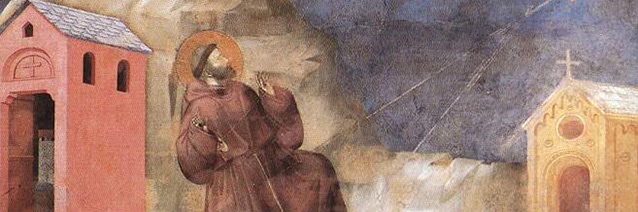
St. Francis receiving the Stigmata _detail__ by Giotto de Bondone from the Legend of St. Francis_ 1297-1300. San Francesco_ Upper Church_ Assisi_ Italy.
St. Francis receiving the Stigmata (detail), by Giotto de Bondone from    
the Legend of St. Francis, 1297-1300. San Francesco, Upper Church, Assisi, Italy.    
Alternative Orthodoxy: Week 1
A Different Worldview
Monday, February 8, 2016
Before we begin to outline Franciscan alternative orthodoxy, it is helpful to look at the Franciscan worldview, which grew out of the historical and cultural context in which St. Francis lived. Today's meditation will be a little longer to give a full background.
 
Francis was born in Assisi, Italy, in the year 1181. He died in 1226. It was a time of great social and economic change and much violence between Italian city-states. Before and during his life, Europe and the Muslim world were involved in four Crusades, and there were more to come. Christians were fighting Muslims; Muslims had overtaken what Christians considered their holy places in Jerusalem; and the Christians of the West were fighting the Eastern Orthodox Christians. Added to that, Assisi itself was in an ongoing war with Perugia, a little city to the west. In the year 1202, Francis was taken prisoner in a battle against Perugia. In 1204, he escaped from prison. He emerged dazed, disillusioned, and deeply hoping for something more, something different than all the terrible violence that had destroyed his youth. His world was obsessed with war, with security, with self-protection, and with fear of the outsider. (Does this sound familiar?) Everyone in Assisi was armed; revenge, scapegoating, cruelty, torture, and aggression against enemies were rampant and even socially sanctioned and idealized, much as they are today.
 
Francis seemed to realize that there was an intrinsic connection between violence and possessions, power, and prestige. So he rejected all of them. His father was among the first generation of the new propertied business class. Francis recognized that his father's obsession with money and property had destroyed his father's soul, and so he set out on a very different path. Francis concluded that the only way out of such a world was to live a life of voluntary poverty or "non-possession." He refused to be part of the moneyed class because he knew that once you owned something you'd have to protect it, and for some reason, you would inevitably try to get more of it. Francis said, "Look, Brothers, if we have any possessions, we will need arms to protect them. . . . Therefore, we do not want to possess anything in this world."
 
Francis felt that in order to find a way out, he had to live in close proximity and even solidarity with the excluded ones in his society. He literally changed sides. He had been born among the upper class in Upper Assisi. In the lower part of town lived the lower class. Francis not only moved to the other side of town, but he actually moved to the plain below Assisi where there was a leper colony. The word "leper" did not always refer to the contagious disease. Rather, the lepers in both Jesus' and Francis' times represented the excluded ones, the ones whom society had decided were unacceptable, unworthy, or unclean for a number of reasons. Francis told us to identify not with the upper class and the climb toward success, power, and money, but to go to where Jesus went--to where there was pain, to the excluded ones. We were to find our place not in climbing but in descending, not at the top but at the bottom, not among the insiders but with the outsider. What an upside down world!
 
Francis, seeing the beginnings of the propertied leisure class, told us to work for our pay; and if work was not available, we were to humbly beg, just as the Buddha advised his monks. Francis recognized that his society was becoming a structured system of protected and unequal social relationships. He knew the violence, mistrust, ambition, and pride which that worldview would engender. So he insisted on what he called equal power relationships in religious communities. He rejected all titles like Superior or Abbot. Francis did not want anyone to act as if he was higher than anyone else. Even those who led the community were to be called friars or brothers, and they only held the office for a short term and then returned to the equality of brotherhood. No one should stay at the top for very long; and when they were there, they were to be servant leaders or "guardians" of the mission and message of the friars.
 
In Francis we see the emergence of a very different worldview, a worldview that is not based on climbing, achieving, possessing, performing, or any idealization of order, but a life that enjoys and finds deep satisfaction on the level of naked being itself--much more than doing or having. He learned this from Jesus. It seems to me the Franciscan worldview is now desperately important if the 7.4 billion of us are going to exist happily together on this one limited planet. Voluntary simplicity is now essential for social survival. Francis warned us where we were headed eight hundred years ago.
Gateway to Silence
Love with your whole heart, soul, mind, and body.
Reference:
Adapted from Richard Rohr, The Art of Letting Go: Living the Wisdom of Saint Francis (Sounds True: 2010), disc 1 (CD).
"Most of us were taught that God would love us if and when we change. In fact, God loves you so that you can change. It is the inherent experience of love that becomes the engine of change."
 --Richard Rohr 

 Join Fr. Richard for a live webcast:
Authentic Transformation
Tuesday, February 23, 2016
4:30-6:00 p.m. US MST* 

Thursday, January 21, 2016

Petitions/Prayer of the Faithful for January 24, 2016

Here are the petitions Ellen McHugh has written for next Sunday, January 24, 2016. St. Mary's Church in Painesville, Ohio.

Prayer of the Faithful for January 24, 2016
Third Sunday in Ordinary Time

Celebrant: The Lord Jesus came to proclaim liberty to the captives and salvation to all.  This gives us confidence to entrust to him all our needs.

·      We pray for those who govern nations and make laws: for the wisdom and courage to honor the dignity of all human life from conception until death. We pray to the Lord.

·      That our loving God, who always hears the cries of the refugee and the immigrant, may enable men and women of good will to hear those cries and be moved to conversion and transformation. We pray to the Lord.

·      Teach us in our daily lives to show mercy as we walk together as one body in Christ; help us to welcome not only the strangers in our midst, but the gifts they bring as well.  We pray to the Lord.

·      For those who directly minister to the most vulnerable among us; for the sick and the dying, for those who struggle with addiction, for those who feel isolated or forgotten.  We pray to the Lord. 

·      Bless all whose lives are closely linked with ours—let the words of our mouths and the thoughts of our heart always speak your truth with compassion.  We pray to the Lord.

·      And for those for whom this Mass is offered [name them]. We pray to the Lord.

·      Let us pause now and silently offer to the Father our own particular intentions [allow for silence. . .].  We pray to the Lord.

Celebrant: Gracious God, we welcome the Gospel of Your Son.  As you answer our prayers, may the words of the Gospel resound in our hearts and shape our lives.  We ask this through Christ our Lord.  Amen   


Wednesday, January 20, 2016

What Five-Year-Old Boys Love . . .

Teenage-Mutant-Ninja Turtles!

Colin with his Ninja Turtles

The Turtles' Domain
And his favorite is Leo (Leonardo). The Turtles all have the names of Renaissance artists: Leonardo, Michelangelo, Raphael, and Donatello. I have a lot to learn about Ninja Turtles!

Sunday, January 17, 2016

Willie Nelson sings there's 'room for everyone' in America | PBS NewsHour

Willie Nelson sings there's 'room for everyone' in America | PBS NewsHour: Willie Nelson has weighed in on the debate over Syrian refugees. In front of a crowd that included a smattering of lawmakers, the outlaw country musician sang that there’s “room for everyone” in America.

Friday, January 15, 2016

Poem for Robby. And Another for the Little One

Portrait of Robby at Two

When Robby wakes up after his nap,
(And this boy is one good napper),
He lies in bed awhile and talks.
Sometimes he practices sounds or words.
One day I heard him say the word “yes”
At least ten times. “Yes!” “Yes!” and “Yes!”

If I come visit him and walk into the house with my shoes on,
Robby points to my shoes, then pulls them off,
Carries them to the door, sets them in perfect order—

He is like me, his Grandfather,
He likes order—and at the same time,
Loves chaos.

Robby loves to play in his basement,
A paradise for toddlers. He tells his Grandmother,
“Nana, run! Run!”
Then runs in a circle ten times,
Wearing out poor Nana.

When visiting, I ask Robby to show me the fish.
He takes me to the aquarium and shows me
The big ones, the little ones, the blue and the pink.
He loves the fish—wants me to feed them.

Then he takes me by the hand to the piano.
He actually puts my fingers on the keys
And says, “Play, Brrr, play!”
“Play ‘Jingle Bells’!”
He calls me “Brr” like his big brother Colin—
“Brrr”—the bearded grandfather,
A name I love.

This little guy, now two-years-old,
So happy, so much fun,
Such a great teacher to his parents,
Grandparents, and brother.

Bob (“Brrr”) Coughlin / January 2016


Little One,

Just ten weeks knit together in your Mother’s womb,
We love you already,
Pray for you on the perilous journey to birth.

We know you are both strong . . .
And fragile

And we ask the angels to guide you
The thirty weeks more until your birth—

Want you to know what a loving family
You are part of us

Can’t wait for you to know your Mom and Dad,
Your crazy bothers,
Your grandparents,
Aunts, uncles, cousins

And the friends who root for you now,
Who will be your teachers
And playmates.

Little One,

We are so full of gratitude

and hope.

 Bob Coughlin / January 6, 2016