Pope Francis, who is in Havana, Cuba, said this:
But first, before they sleep, Francis said: "Look at the Virgin and remember these faces: the people who love us, those we love, those we don't love, those who don't love us and those who have done us harm."
This is a great man, one who understands what it means to follow Jesus.
Here's a link to the story in the New York Times: Pope Francis in Cuba
Showing posts with label Pope Francis. Show all posts
Showing posts with label Pope Francis. Show all posts
Saturday, February 13, 2016


Tuesday, February 9, 2016
Gun Policy: Trying to Influence It
St. Mary Parishioners Try to Influence Governmental
Policy on Guns
American Catholic Bishops
have spoken out clearly on gun violence and too-easy access to deadly weapons.
Echoing Pope Francis’s call for mercy and peacebuilding in our communities, the
Bishops have asked that America implement reasonable regulations on firearms,
such as: requiring universal background
checks for all gun purchases; limiting civilian access to high-capacity weapons
and ammunition magazines; making gun trafficking a federal crime; and improving
mental health care for those who may be prone to violence.
To this end, three St. Mary
parishioners, Krista Zivkovich, Dan Bergen, and myself, and the leader of the Cleveland
Diocese COAR ministry, Mary Stevenson, met on January 27th with Nick
Ciofani, assistant to US Representative David Joyce. The meeting was held in
Mr. Joyce’s Painesville office and lasted an hour. We introduced ourselves to
Mr. Ciofani and were struck by all the personal connections we had to him and
his family. Then we each proceeded to tell our stories why we were interested
in this issue. The stories were riveting. I told the story told of my nephew Dillon
Coughlin being in the Chardon High school cafeteria during the mass shooting
that took place in 2012, leaving three students dead and one paralyzed for
life. I also told of gun suicides of Lakeland College colleagues: our long-time
psychology professor, a campus police officer, and one of my creative writing
students. These tragic deaths profoundly affected me, my friends and family. Dan
told of his wife’s work as an emergency room nurse and all the terrible
shootings she had to deal with over the years. Mary Stevenson, the representative
from the diocese’s COAR office, told how she herself had been shot in 1988, and
the lifelong physical injuries she lives with. Krista told of her best friend’s
suicide, a friend who was her son’s Godmother. In an astonishing twist of fate,
that suicide victim was also the Godmother of Nick, Representative Joyce’s
aide.
After telling our personal
stories, we presented petitions signed by 134 St. Mary parishioners asking for
reasonable limitations on gun availability. And we asked Nick to present these
to Representative Joyce along with our hope that action could be taken in the
future on these issues.
We left the meeting with no
guarantees. But we did establish a relationship with Representative Joyce and
his aide Nick Ciofani, and we did make clear the wishes of American Bishops and
many St. Mary parishioners. We will continue to nurture this connection with
our representative and keep trying to advocate for reasonable gun safety
regulations. Our goal is in line with the goals of Pope Francis, the American
Bishops, and many St. Mary parishioners: a
safer, more merciful, and more just community. We are trying to do our part
in building the Beloved Community, the Kingdom of God on Earth.
Postrcript:
The petitions presented to Representative David Joyce have also been sent to Senators Sherrod Brown and Rob
Portman and to state legislators, Kenny Yuko and John Rogers. Let’s hope that
they pay attention to the wishes of the American Catholic Bishops and many
members of St. Mary’s Church in Painesville, Ohio.
Monday, February 8, 2016
Fr. Richard Rohr's Meditation on St. Francis of Assisi: "Alternative Orthodoxy"
Hope Fr. Richard Rohr forgives me for re-posting his beautiful essay. This essay speaks to our times, just as Pope Francis does.
Richard Rohr's Daily Meditation
|
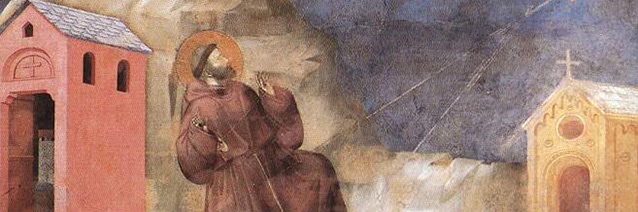
St. Francis receiving the Stigmata (detail), by Giotto de Bondone from
the Legend of St. Francis, 1297-1300. San Francesco, Upper Church, Assisi, Italy. |
|

Alternative Orthodoxy: Week 1
|
|
A Different Worldview
Monday, February 8, 2016 |
Before we begin to outline Franciscan alternative orthodoxy, it is helpful to look at the Franciscan worldview, which grew out of the historical and cultural context in which St. Francis lived. Today's meditation will be a little longer to give a full background.
Francis was born in Assisi, Italy, in the year 1181. He died in 1226. It was a time of great social and economic change and much violence between Italian city-states. Before and during his life, Europe and the Muslim world were involved in four Crusades, and there were more to come. Christians were fighting Muslims; Muslims had overtaken what Christians considered their holy places in Jerusalem; and the Christians of the West were fighting the Eastern Orthodox Christians. Added to that, Assisi itself was in an ongoing war with Perugia, a little city to the west. In the year 1202, Francis was taken prisoner in a battle against Perugia. In 1204, he escaped from prison. He emerged dazed, disillusioned, and deeply hoping for something more, something different than all the terrible violence that had destroyed his youth. His world was obsessed with war, with security, with self-protection, and with fear of the outsider. (Does this sound familiar?) Everyone in Assisi was armed; revenge, scapegoating, cruelty, torture, and aggression against enemies were rampant and even socially sanctioned and idealized, much as they are today.
Francis seemed to realize that there was an intrinsic connection between violence and possessions, power, and prestige. So he rejected all of them. His father was among the first generation of the new propertied business class. Francis recognized that his father's obsession with money and property had destroyed his father's soul, and so he set out on a very different path. Francis concluded that the only way out of such a world was to live a life of voluntary poverty or "non-possession." He refused to be part of the moneyed class because he knew that once you owned something you'd have to protect it, and for some reason, you would inevitably try to get more of it. Francis said, "Look, Brothers, if we have any possessions, we will need arms to protect them. . . . Therefore, we do not want to possess anything in this world."
Francis felt that in order to find a way out, he had to live in close proximity and even solidarity with the excluded ones in his society. He literally changed sides. He had been born among the upper class in Upper Assisi. In the lower part of town lived the lower class. Francis not only moved to the other side of town, but he actually moved to the plain below Assisi where there was a leper colony. The word "leper" did not always refer to the contagious disease. Rather, the lepers in both Jesus' and Francis' times represented the excluded ones, the ones whom society had decided were unacceptable, unworthy, or unclean for a number of reasons. Francis told us to identify not with the upper class and the climb toward success, power, and money, but to go to where Jesus went--to where there was pain, to the excluded ones. We were to find our place not in climbing but in descending, not at the top but at the bottom, not among the insiders but with the outsider. What an upside down world!
Francis, seeing the beginnings of the propertied leisure class, told us to work for our pay; and if work was not available, we were to humbly beg, just as the Buddha advised his monks. Francis recognized that his society was becoming a structured system of protected and unequal social relationships. He knew the violence, mistrust, ambition, and pride which that worldview would engender. So he insisted on what he called equal power relationships in religious communities. He rejected all titles like Superior or Abbot. Francis did not want anyone to act as if he was higher than anyone else. Even those who led the community were to be called friars or brothers, and they only held the office for a short term and then returned to the equality of brotherhood. No one should stay at the top for very long; and when they were there, they were to be servant leaders or "guardians" of the mission and message of the friars.
|
 |
|
Gateway to Silence
Love with your whole heart, soul, mind, and body.
|
|
Reference:
Adapted from Richard Rohr, The Art of Letting Go: Living the Wisdom of Saint Francis (Sounds True: 2010), disc 1 (CD).
|
|
"Most of us were taught that God would love us if and when we change. In fact, God loves you so that you can change. It is the inherent experience of love that becomes the engine of change."
--Richard Rohr
Join Fr. Richard for a live webcast:
Authentic Transformation Tuesday, February 23, 2016 4:30-6:00 p.m. US MST* |
Wednesday, December 16, 2015
Christmas Alleluia at My Parish, St. Mary's in Painesville, Ohio
Christmas Alleluia at
St. Mary’s Painesville
On Tuesday, December 15th, at 8 PM, I drove to
St. Mary’s to pick up my wife, who was finishing up teaching her PSR catechism class.
St. Mary’s has a very fine PSR program, directed by Dr. Shanon Sterringer, and
made possible by many dedicated teachers. At the end of class, several of the
8-10 year old Latino students in my wife’s class asked to be excused to go next
door to the Fr. Hanzo Center, where the Posados
celebration was beginning. This is an ancient religious novena, 9 evenings,
celebrated in parts of Mexico, Central and South America, and in a few
communities in the United States—including Painesville, Ohio. To my
astonishment, there was a procession of about 100 people, led by children
dressed as Mary and Joseph, some people carrying candles, and almost everyone
singing. The song was a dialogue between Mary and Joseph, desperately seeking shelter,
and innkeepers, who responded that there was no more room. What a wonderful
celebration of our faith—right here at St. Mary’s in Painesville, Ohio.
At the very moment this was taking place, members of several
churches and St. Mary’s, including our music ministry, were holding a Christmas
sing-along/liturgy in the Lake County Jail. They were meeting three large
groups of imprisoned men and women—singing and praying with them, being with
them, bringing comfort and companionship and the beauty of our Christianity to
those who have temporarily lost their freedom.
These were three of the activities going on, almost
simultaneously, in our parish, a community that is answering the call of Pope
Francis for mercy, reconciliation, and celebration. Our parish is singing out,
loud and clear, a Christmas Alleluia!
Friday, December 4, 2015
"Just Thoughts" for December 6, 2015
Krista and Ed Zivkovich have submitted this "Just thoughts" essay for the December 6, 2015 bulletin of St. Mary's parish in Painesville, Ohio:
Just Thoughts
"We must be the
change we wish to see in the world."
Gandhi
In his encyclical, Laudato Si, Pope
Francis called for a global effort to combat climate change. This week and next, representatives from over
190 countries are attending the United Nations Climate Change Conference in
Paris to discuss actions which could ultimately result in less greenhouse gas
emissions that harm our planet, causing rising sea levels and temperatures with
potentially devastating effects around the world. Pope Francis wrote,"A global consensus
is essential for confronting the deeper problems, which cannot be resolved by
unilateral actions on the part of individual countries."
While heads of state, representatives
of nations, scientists and others address this critical issue, Pope Francis
reminds us,"Living our vocation to be protectors of God's handiwork is
essential to a life of virtue; it is not an optional or secondary aspect of our
Christian experience." (217). We
all have a stake in and responsibility to care for our planet Earth. Following
are 4 challenges from Pope Francis' encyclical prepared by the Archdiocese of
Washington that are especially appropriate during this Advent season of waiting
and reflecting.
1. Celebrate
Beauty - "See nature as a magnificent book in which God speaks to us
and grants us a glimpse of his infinite beauty and goodness...The world is a
joyful mystery to be contemplated with gladness and praise." Action: Take time to be outside! Find
the natural beauty in your community, and in doing so offer thanks to God for
the beauty of all created things, including one another."
2. Live
in a Global Community - "We must regain the conviction that we need
one another, that we have a shared responsibility for others and the world, and
that being good and decent are worth it." (229). Action: Make a commitment this week to
serve the needs of the poor in a concrete way."
3. Slow
Down & Unplug - "Inner peace is closely related to care for
ecology and for the common good because, lived out authentically, it is
reflected in a balanced lifestyle together with a capacity for wonder which
takes us to a deeper understanding of life. Nature is filled with words of
love, but how can we listen to them amid constant noise..." (225). Action:
Find time each day, especially on Sunday's, for quiet moments to talk with and
listen to God.
4. Practice
Small Acts of Love - "St. Therese of Lisieux invites us to practice
the little way of love, not to miss out on a kind word, a smile or any small
gesture which sows peace and friendship. An integral ecology is also made up of
simple daily gestures which break with the logic of violence, exploitation and
selfishness." (230). Action:
Practice a new small act of love as a way of living solidarity with those most
in need and being a more responsible steward of God's gifts. For example, reuse
& recycle, reduce water consumption & electricity use, avoid using
plastic bottles and bags.
Pope Francis Speaks Out About Basic Human Rights
Pope Francis, While in Africa, Speaks of Basic Human Rights
[from the Amecea News Blog:
http://amecea.blogspot.com/2015/11/kenya-access-to-safe-drinkable-water-is.html]
Pope Francis has
denounced the conditions slum-dwellers are forced to live in and said that
access to safe water is a basic human right and that everyone should have
dignified, adequate housing.
Speaking at Kangemi Slum
in Nairobi during the last day of his visit Pope Francis said “Our world has a
grave social debt towards the poor who lack access to drinking water, because
they are denied the right to a life consistent with their inalienable dignity
(Laudato Si’, 30). …. To deny a family water, under any bureaucratic pretext
whatsoever, is a great injustice, especially when one profits from this need.
Residents of the Kangemi
slum lined up along the streets to welcome Pope Francis. Those lucky enough to
score access to St. Joseph's parish erupted in cheers and hymns when Francis
arrived at the open-sided church that serves the slum of about 50,000 people.
“I am here because I want
you to know that your joys and hopes, your troubles and your sorrows, are not
indifferent to me. I realize the difficulties which you experience
daily! How can I not denounce the injustices which you suffer?” Pope
Francis asked.
On issue of
infrastructure Pope Francis said that it is a serious problem if one lacks access
to infrastructures and basic services. “By this I mean toilets, sewers,
drains, refuse collection, electricity, roads, as well as schools, hospitals,
recreational and sport centers, studios and workshops for artists and
craftsmen,” he said.
The Holy Father urged the
authority to work with the people living in the slums upon the path of social
inclusion, education, sport, community action, and the protection of families,
for this is the only guarantee of a peace that is just, authentic and enduring.
In the conclusion of his
speech Pope Francis said, “Dear neighbors, dear brothers and sisters, let
us together pray, work and commit ourselves to ensuring that every family has
dignified housing, access to drinking water, a toilet, reliable sources of
energy for lighting, cooking and improving their homes; that every neighborhood
has streets, squares, schools, hospitals, areas for sport, recreation and art;
that basic services are provided to each of you; that your appeals and your
pleas for greater opportunity can be heard; that all can enjoy the peace and
security which they rightfully deserve on the basis of their infinite human
dignity.”
Subscribe to:
Posts (Atom)