Thursday, August 15, 2013

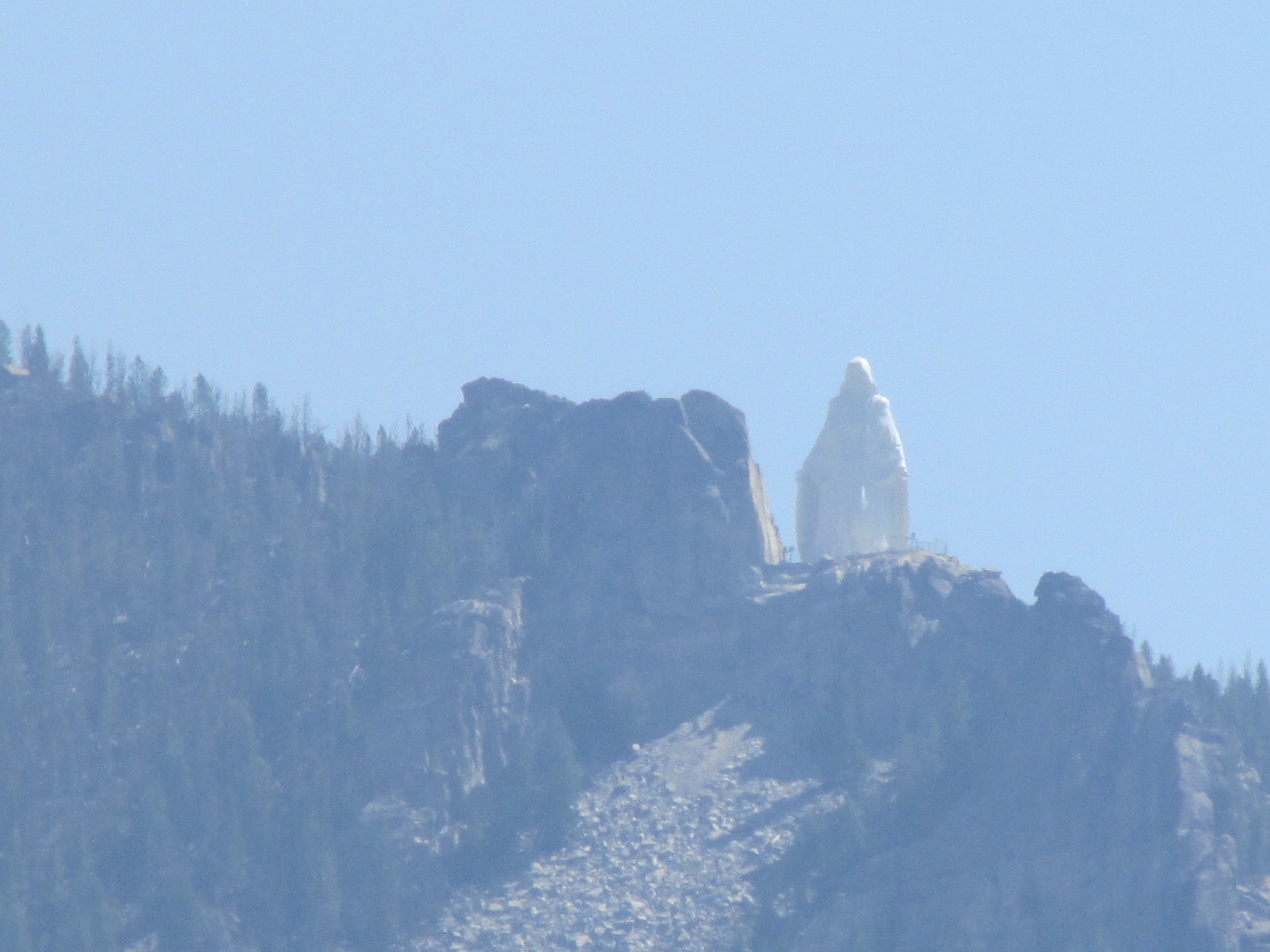
Our Lady of the Rockies--over Butte, Montana

A beautiful, gigantic statue of Our Lady sits on the Continental Divide (elevation 8510 feet) overlooking the city of Butte, Montana. It is an astonishing sight to be sure. The statue is non-denominational, dedicated to all women, especially mothers.

Information on it can be found here: Our Lady of the Rockies Website.

The statue is 90 feet in height and is a stunning eggshell white color. Despite its enormous size, it can't be seen as well as might be expected (it's 3500 feet above the city and a few miles away).

Below are some photos from the web site:


Our Lady--photo taken from Berkeley Pit, Butte, Montana


Wednesday, August 14, 2013

Schoenigkeit!

A Beautiful Girl--A Happy Girl

Ring-around-the-Rosie

My grandson plays ring-around-the-rosie with his new friend Hannah. At the end he asks her, "Are you happy?"


Tuesday, August 13, 2013

Butte, Montana and the Berkeley Pit--An Environmental Disaster for the Ages

Recently I visited Butte, Montana, while on my way to Kalispell and Glacier National Park to visit my daughter Carolan. I am interested in Butte because a hundred years ago it was a town of Irish immigrants (and other ethnic groups). It was so Irish that Gaelic was often spoken in town. The city of Butte, which once had a population of almost 100,000 souls, lay atop a fortune in silver, gold, and copper ore. In 1955, the Anaconda Copper Company began strip mining under the town. To do this they bought out the residents and annihilated the Dublin Gulch, Finn Town, and other neighborhoods. They didn't stop this open pit mining until 1982 when they left a hole a mile across and almost 1800 feet deep. When Atlantic Richfield (ARCO), which had succeeded Anaconda, abandoned the mine, they turned off the water pumps at the bottom of the pit. The pit filled with water, almost to the point that the drinking water supply was destroyed. The pit is now filled with highly acidic water, with the acidity of lemon juice. This acid water leaches out arsenic, lead, and other heavy metals and poisonous substances from the rock. There are so many heavy metals in the water that they are now trying to mine the water!

I don't think this incredible environmental disaster can ever be fixed. What is particularly disturbing is that it happened so recently--when we knew better. Butte appears to be a ruined city at the heart of a ruined county. An incredible statue overlooks the city of Butte (now about one third its former size) from atop the Continental Divide--Our Lady of the Rockies. It will take the environmental Superfund, and the power of the saints like Our Lady, to restore this historic city.

The Berkeley Pit, Butte, Montana
Another view of the Pit, looking toward the mountain of Our Lady of the Rockies

Colin Jude--The Next Mozart?


Friday, August 9, 2013

Poem Honoring the Retirement of Fr. Francis P. Walsh

Fr. Francis P. Walsh

I just heard that Fr. Francis P. Walsh, priest of the diocese of Cleveland, is retiring. Fr. Walsh is remembered very fondly by me and my brothers and sister for his years of service at St. William's in Euclid (1957-1962). My mother and father were also very fond of Fr. Walsh. Below is a poem I wrote some time back that mentions Fr. Walsh. The poem takes some minor liberties with historical fact:

Sr. Muriel’s Boys’ ChoirSt. William’s Church, Euclid, Ohio, 1959

Solemn High Midnight Mass, near the end of an era
(one that would end in gunfire from a grassy knoll in Dallas,
In a hellfire of napalm and Agent Orange in Vietnam,
And a medieval Church damaged by patriarchy and the weight of time) . . .

There in that modest church on East 260th Street,
In a working-class suburb of a city in its death rattle,

Right there, 28 boys led by an Irish nun of the Ursuline order,
Sang so beautifully it would make the angels weep.

In the hushed darkness of midnight, as Monsignor John Fleming
Processed into the church, with Fr. Walsh as deacon, and Fr. Praznik as subdeacon,
Behind a cross raised high and candles lit against the darkness,

The boys sang “Gesu Bambino,” in English:

When blossoms flowered 'mid the snows
Upon a winter night,
Was born the Child, the Christmas Rose,
The King of Love and Light.

The organist played softly as the boys’ voices soared:

The angels sang, the shepherds sang,
The grateful earth rejoiced;
And at His blessed birth the stars
Their exultation voiced.

And then the chorus, “Venite adoremus”:
O come let us adore Him,
Christ the Lord.
As Monsignor Fleming mounted the steps to the altar,
The church lights came on, and for the last time in the season, we sang “Adeste Fidelis.”
We sang it in perfect church Latin diction, following Sr. Muriel’s instructions for each syllable.

Fr. Fleming began the mass, “In nomine Patris, et Filii, et Spiritus Sancti . . . .”
Then, “Introibo ad altare Dei.”

Two eighth grade boys, in surplices and cassocks, responded,
“Ad Deum qui laetificat juventutum meum.”
The response was quick and natural—and not fully understood by the boys
Or the hundreds of people in the pews. In three or four years
This Latin would be obsolete, not to be heard again.
The medieval period, which stretched across hundreds of years,
Was ending. And yes, good riddance! Yet—

There was great beauty and pageantry there,
And to this little choir boy,

Mystery and power in the Latin,
The incense, the sincere prayers of so many of these people,
My friends and neighbors (so many of them now gone).

When it was over, about 1:30 a.m.,
I walked out of the church into the brisk, snowy night,
And walked, my 11-year-old self, the mile home,
Down East 262, to Forestview, to East 266, then home.

All was silence, that night so long ago, as I entered the dark house,
Past the darkened Christmas tree, the unopened presents,
Up the stairs to where Denny and I shared a room.

And I fell asleep, the last Christmas of the Medieval,
With “Gesu Bambino” dancing in my brain,

And hoping one of the presents under the tree was a pair of baseball spikes.

[Bob Coughlin. Chardon, Ohio. January 6, 2013]


My sister Mary Ellen sent me a photo of Fr. Walsh and his sister Maggie--from father's retirement party:

Fr. Francis P. Walsh and his sister Maggie


Thursday, August 8, 2013

A Few Pictures from Yellowstone National Park

Old Faithful--Yes, it is impressive!
Lower Falls of the Yellowstone, with the Grand Canyon of the Yellowstone.
One of the wonders of the world.
Travertine "steps," created by the mineral-laden waters of the hot spring. Mammoth Hot Springs, Yellowstone.
A buffalo swimming the Yellowstone River. We saw hundreds of buffalo.
The Roosevelt Arch,at the northern end of Yellowstone. It reads,  "For the Benefit and Enjoyment of the People."